---
title: "Schrödinger's Pull Requests: The 1,553 Next.js PRs With No Review"
description: "Next.js has a backlog of 1,553 pull requests that no one has reviewed in over a month. This article looks at the numbers for the projects that beginner guides recommend, then lists six open source projects to contribute to in 2026 where a maintainer reads your work within days and helps you get it merged."
canonical_url: "https://oxynote.io/blog/open-source-projects-2026"
---
> Index of every page on this site: [llms.txt](https://oxynote.io/llms.txt)
In March 2025, 255,000 people made their first open source contribution. GitHub's [Octoverse report](https://github.blog/news-insights/octoverse/octoverse-a-new-developer-joins-github-every-second-as-ai-leads-typescript-to-1/) called it the largest month of first-timers in its history, and open source has only got busier since: [this year's report](https://github.blog/news-insights/octoverse/octoverse-commits-pushes-reach-new-highs-in-2026-as-developers-build-with-agents/) counts 2.5 billion public contributions, more than double the year before. For anyone who wants to join in, plenty of guides say where to start. [One written for beginners](https://www.designgurus.io/blog/10-open-source-tools-for-beginners) is also honest about why you would:
If you list open source contributions on your resume, it shows hiring managers that you have practical, real-world experience.
One of its ten picks is Next.js. Yet on the 19th of November 2026, Next.js had 1,553 open pull requests that were more than a month old and had never been reviewed. A beginner's pull request joins the back of that queue.
React is on the same list, with the note that "the maintainers welcome community involvement". Still, it had 400 pull requests in the same state on that day.
I think of pull requests in that state as Schrödinger's pull requests. Schrödinger imagined a cat in a sealed box that counts as both alive and dead until someone looks. A pull request that nobody reviews is the same: neither merged nor rejected, until a maintainer opens the box.
For a newcomer, a box that stays shut costs more than time. The pull request inside can't be merged, and it gets no feedback either. So you learn nothing from it, and you have nothing to show a hiring manager. And if you were in it for the love of the project, hoping to see a few lines of your own in something millions of developers use, that doesn't happen either.
Fortunately, there are better places to start. This article lists six of them: projects that set work aside for newcomers, where a maintainer reads your pull request within days, tells you what to change and merges it when it's ready.
## What the Usual Picks Look Like
First, the usual advice deserves a closer look. I took a handful of the big projects that guides for beginners recommend, in lists such as [DesignGurus'](https://www.designgurus.io/blog/10-open-source-tools-for-beginners), [Index.dev's](https://www.index.dev/blog/open-source-github-projects) and the [awesome-for-beginners](https://github.com/MunGell/awesome-for-beginners) list, which has more than 91,000 stars on GitHub, and counted what happened to the pull requests that were opened by outside contributors (people who aren't public members of the project's organisation, with bots left out). The window is two months, the 21st of August to the 20th of October 2026, read on the 19th of November, so each pull request had at least 30 days to get an answer.
"Still open a month later" is the share of those pull requests that has been neither merged nor closed. "Never reviewed" counts all of a project's open pull requests, drafts excluded, that are older than 30 days and have no GitHub review. Kubernetes reviewers [can approve](https://github.com/kubernetes/community/blob/master/contributors/guide/owners.md) by typing `/lgtm` in a plain comment instead, so the last column may be less accurate for that project. If you want to know where these numbers come from, I explain it [at the end of the article](#how-the-numbers-were-counted), with the queries and scripts I used in case you'd like to check them.
The table counts only pull requests that are still open, because a closed one at least got an answer, even if the answer was no. That covers getting a review. Finding something to work on is the other half, and the usual way in for a newcomer, a starter issue, is hard to come by too. Deno, for one, has no starter label at all. The other five have a `good first issue` label, yet in the last 90 days React, Next.js and scikit-learn closed no issue with that exact label, and Kubernetes closed one. PyTorch did best with 14, in a project that received more than 5,800 pull requests in two months.
Then there is the code itself. These codebases are large and complex, and the projects say so themselves. scikit-learn's [contributing guide](https://scikit-learn.org/dev/developers/contributing.html) is the most direct:
Contributing to the project code generally requires advanced skills, and it may not be the best place to begin if you are new to open source contribution.
The same page explains why the team rarely uses the `good first issue` label: such issues "often prove more complex than originally anticipated". The Kubernetes maintainers say something similar and warn in their [first-contribution guide](https://github.com/kubernetes/community/blob/master/contributors/guide/first-contribution.md) that "it may be difficult to find which [special interest group] your contribution belongs in", and that group is the one that reviews your work.
Put the queue and the complexity together and you see the trap. In a mature, complex codebase a newcomer needs a maintainer's help more than anywhere else: someone to say which file to open, why a test fails, what the change breaks. And these are the projects where maintainers have the least time to give it.
None of this makes them bad projects. They are some of the most used software there is, and reading their code is worth your time. Their maintainers are also dealing with a flood. GitHub reports that by September 2026 more than 40% of pull requests on the platform [started with an AI agent's first draft](https://github.blog/news-insights/octoverse/octoverse-commits-pushes-reach-new-highs-in-2026-as-developers-build-with-agents/), up from 17% in March, and somebody still has to review those. They're just a hard place to make a first contribution, because a first contribution needs somebody on the other side.
## Six Open Source Projects to Contribute to in 2026
So I looked for the opposite: projects where a maintainer has time for you, and where the work itself is worth your evenings. Each of the six passes five checks:
- Pull requests are reviewed quickly, usually within a day or two, and few are left waiting.
- The project sets small issues aside for newcomers, or its ordinary issues are easy to pick up.
- The rules are written down, so you know before you start whether your work can merge.
- Maintainers answer questions, in the issue or in a chat you can join.
- The project is interesting to work on: it solves a problem you can explain to a friend, and its stack teaches you something you can use elsewhere.
### Kestra: Workflow Automation for Java Developers
If Java is your thing, [Kestra](https://github.com/kestra-io/kestra) is the project to look at. Kestra runs workflows: you describe a pipeline in YAML, and it schedules the tasks, reacts to events and retries what fails. Working on it shows you how scheduling, queues and retries are built in a real system.
The backend is Java on Micronaut, and the interface is Vue. In the last 90 days Kestra closed more than 650 issues labelled `good first issue`, about seven a day. No other project here comes close. A typical pull request merges within two days, and very few are left waiting.
One rule to know first: comment on the issue and wait until it is assigned to you. The [contributing guide](https://github.com/kestra-io/kestra/blob/develop/.github/CONTRIBUTING.md) says a pull request for an unassigned issue may "take longer to review, or be closed in favor of work that is already underway". It also offers a dev container for VS Code, so you can skip setting up Java 25 by hand.
### SQLFluff: A Linter With a Clear First Task
Python people get a linter, though not for Python. [SQLFluff](https://github.com/sqlfluff/sqlfluff) lints and auto-formats SQL, and it understands the dialects that make SQL awkward: BigQuery, ClickHouse, Databricks and many more. Each database bends the language a little differently. That is the interesting part, because teaching a parser one more piece of syntax is a self-contained task with a clear finish.
Its [contributing guide](https://github.com/sqlfluff/sqlfluff/blob/main/CONTRIBUTING.md) tells a newcomer where to begin:
Dialect additions are often a good entry point for new contributors
It then says what gets such a change merged. A dialect update "will normally be accepted directly" when it comes with YAML test cases and matches the database's published syntax. So you know the bar before you change a line of code, and you don't need to wait for a starter issue: find a query in your own dialect that SQLFluff can't parse.
A typical pull request merges within two days, and hardly anything is left waiting. If you used AI tools in a material way, the guide asks you to say so in the pull request.
### Biome: Rust for People Who Write JavaScript
Want to learn Rust while you write JavaScript for a living? [Biome](https://github.com/biomejs/biome) formats and lints JavaScript, TypeScript, CSS and more, and it is written in Rust. You know what the tool should do before you read a line of its code, which saves a lot of reading. A lint rule is also a tidy piece of work, small enough to finish and with tests of its own.
Biome has more than 750 lint rules, and its [contributing guide](https://github.com/biomejs/biome/blob/main/CONTRIBUTING.md) has separate sections on writing a rule, the parser and the formatter. It also has a ready GitHub Codespace, in case you'd rather not install a toolchain yet. Once your pull request is in, you can expect an answer: of those that outside contributors opened this autumn, 93% had one within a month. To find a first task, look for the `S-Good first issue` label. Those issues get claimed fast, so check it often.
Two things to respect. The guide reminds you that "we are doing this project on our own time", so a typical pull request takes a couple of days to merge. And if you used AI assistance, you must say so in the pull request.
### prek: The Smallest Codebase Here
If Biome looks too big for a first Rust project, [prek](https://github.com/j178/prek) is a gentler place to start. It runs git hooks, as a drop-in replacement for [pre-commit](https://pre-commit.com/), in a single binary with no Python needed. Its README lists CPython, Apache Airflow and FastAPI among its users.
prek is the least predictable project on this list, because one maintainer writes most of the code. When a pull request from someone else merges, it typically takes 18 hours. But of the twelve that outside contributors opened this autumn, four are still open a month later. The upside is its scope. A hook runner does one job, and prek is the smallest codebase on this list. Finding the code behind an issue takes far less reading than in the other five. That matters, because prek's `good first issue` label has no open issues under it, so you'll have to pick an ordinary one. The [contributing guide](https://github.com/j178/prek/blob/HEAD/CONTRIBUTING.md) is one page, and most of it teaches snapshot testing with `insta`, a skill you'll reuse in other Rust projects.
### Woodpecker CI: A Community-Run Pipeline Server
Back to Go, this time for CI. [Woodpecker](https://github.com/woodpecker-ci/woodpecker) is a CI engine that runs each pipeline step in a container. It was [forked from Drone 0.8 in 2019](https://woodpecker-ci.org/about), after Drone's licence changed, and it is run by its community and funded through Open Collective and GitHub Sponsors. Codeberg uses it as its main CI.
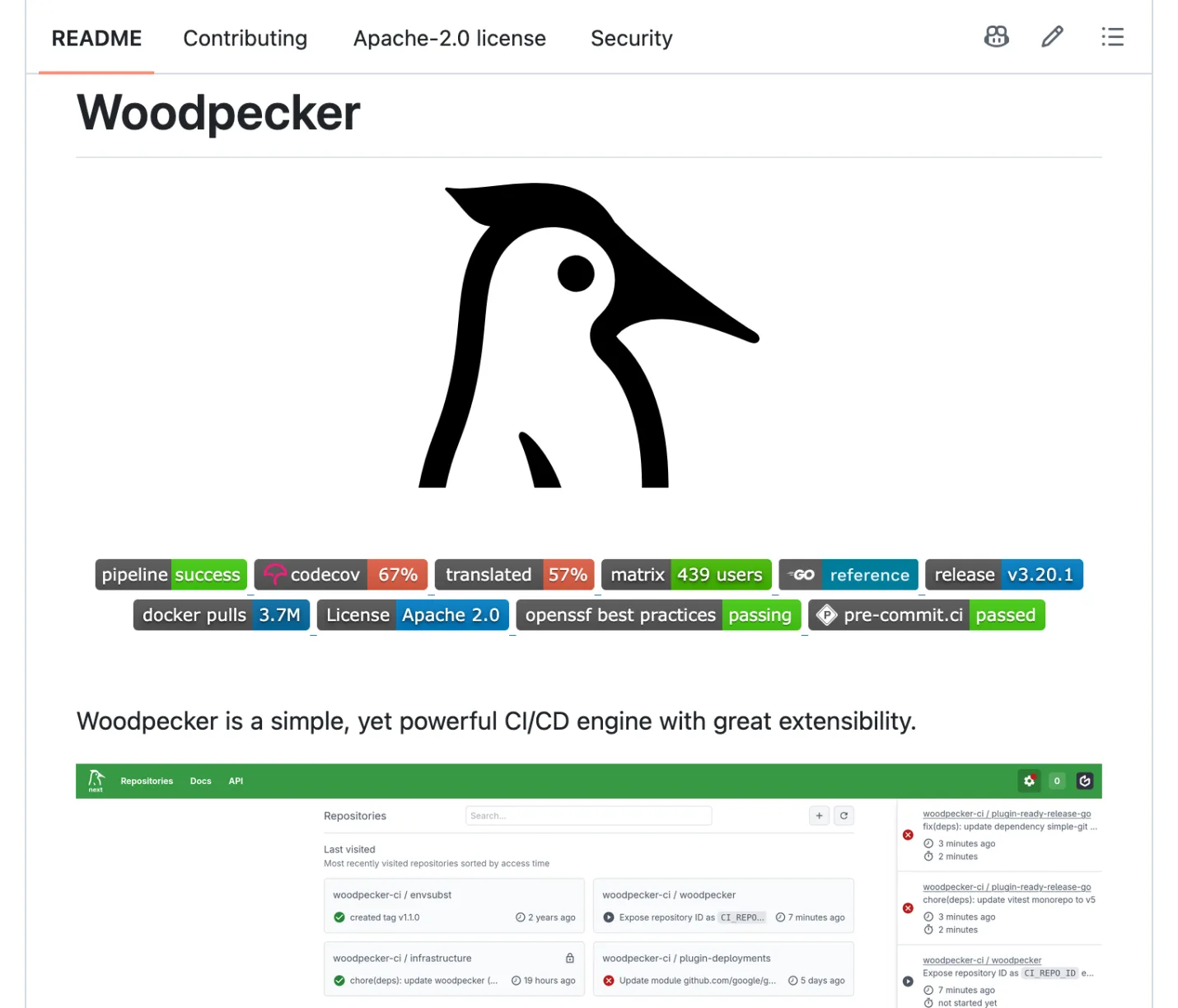
If you've only seen CI from the YAML side, Woodpecker is a manageable way in. It is a Go server and agent with a Vue interface, and the server idles at about 100 MB of RAM. Since late August, 60 people from outside the team have had a pull request merged, and a typical one merges in 14 hours. Starter issues carry the `good first issue` label, but there are only a few at a time, so check it often or pick a regular bug.
Two short pages are worth reading before you start. [Core ideas](https://github.com/woodpecker-ci/woodpecker/blob/HEAD/docs/docs/92-development/02-core-ideas.md) asks two questions of any change: is it specific to your own setup, and does it go against the project's guidelines? If either answer is yes, it belongs in an addon or an extension, not in the core. [Conventions](https://github.com/woodpecker-ci/woodpecker/blob/HEAD/docs/docs/92-development/06-conventions.md) lists the lint rules that "new contributors run into most often", such as no `print` or `panic` in Go code. And if you use Nix, `nix develop` sets up the whole toolchain in one command.
### OpenBao: The Community Fork of Vault
The last of the six is for anyone curious about security. [OpenBao](https://github.com/openbao/openbao) stores secrets and controls who can read them: database credentials, API keys, certificates. It is the fork of [HashiCorp Vault](https://github.com/hashicorp/vault) that the Linux Foundation's OpenSSF [manages](https://openbao.org/), written in Go and licensed under MPL-2.0. Working on it means writing code for encryption at rest, leases and audit logs, which few side projects let you practise.
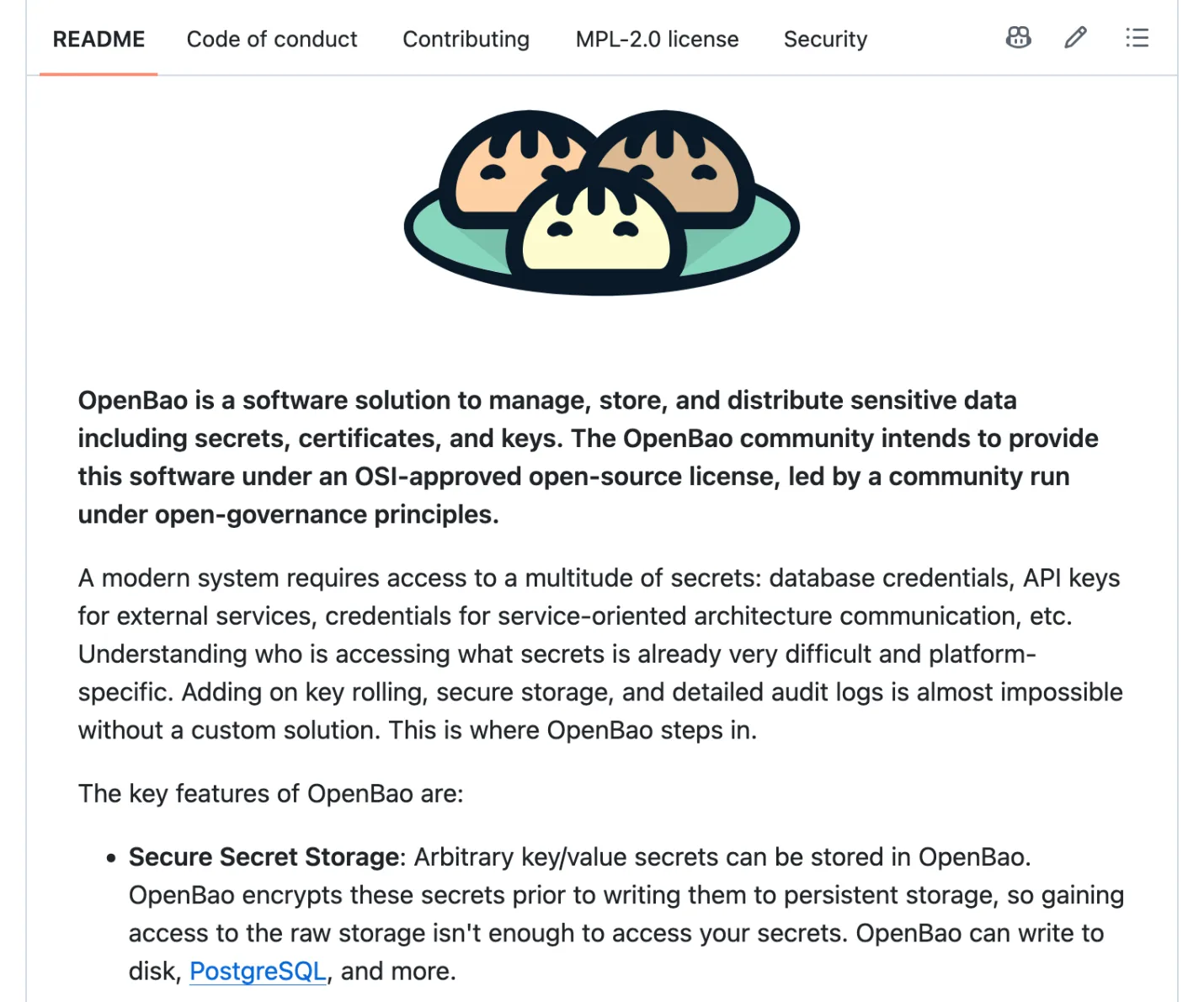
Right now more than 20 issues labelled `good first issue` are open with nobody assigned, so there is something to pick up today. Once you send a pull request, a typical one merges within two days. The [contributing guide](https://github.com/openbao/openbao/blob/HEAD/CONTRIBUTING.md) sets the tone in its first lines:
You won't be yelled at for giving it your best effort.
Read the rest of it before you start, though, because one rule can look scary at first. OpenBao requires a DCO, a [Developer Certificate of Origin](https://developercertificate.org/), on each commit. It is a line saying that you wrote the change, or have the right to submit it, and you add it with `git commit --signoff`.
The project is strict about this for a reason. Its guide forbids copying from any source-available code, HashiCorp's own repositories included, so each contributor has to confirm where their code came from. That is also why it asks you to switch off generative AI agents while you work on OpenBao. It sounds like a lot of legal weight for a first pull request, but the guide explains each step and gives you the exact commands.
## Bonus: Oxynote, a Wiki With Live Charts and Logs
This project is not one of the main six, because I am one of the two people who started it. [Oxynote](https://github.com/oxynote/oxynote) is a self-hosted technical wiki connected to the systems it describes. A page about your payment API, for example, shows that API's live metric charts and logs, from your own Prometheus, Loki or SQL database, next to the text that explains them. Several people can edit a page at once, and a change can be reviewed before it goes live, the way code is. It is built with Go, Vue, Nuxt and Node.js.
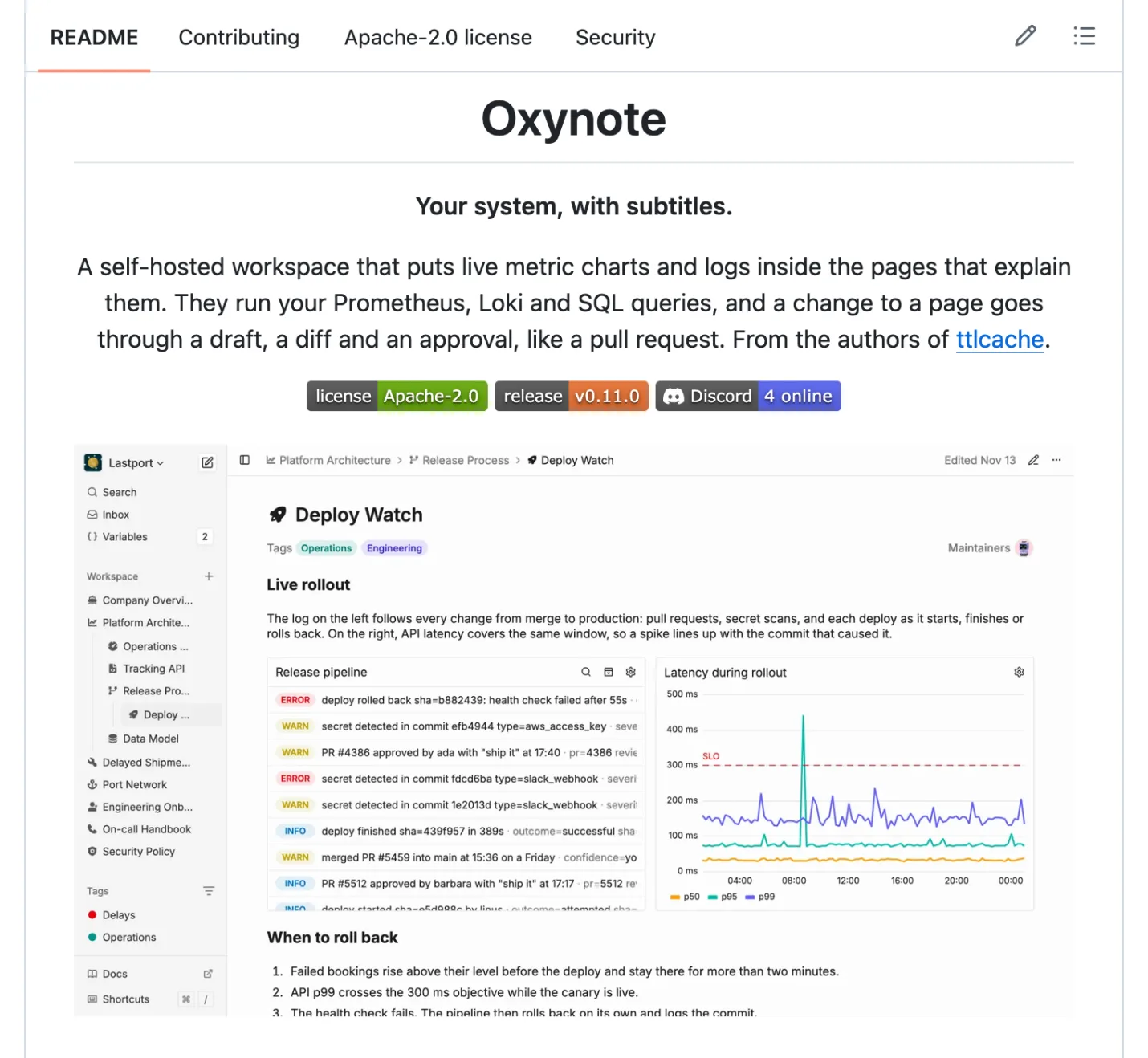
The two of us contributed to other open source projects for years before we started this one, and we wanted ours to do three things. It should be easy to get into, so starter issues are reserved for first-time contributors, one per person, and every issue says which code to change ([here is one](https://github.com/oxynote/oxynote/issues/279)). It should teach you something, so we read a pull request line by line and explain what we'd change and why, in the review or on [Discord](https://discord.gg/mNJd5zJkvC). And it should say thank you, because open source is usually a thankless job. When your work ships, we [credit you in public](https://lnkd.in/p/efW2EhvJ), if you'd like that.
The numbers so far, measured the same way as the ones above: since September, 23 outside contributors have had a pull request merged, a typical one in 15 hours, and no open pull request is older than a month. We added 44 starter issues in the last 30 days.
One thing to know before you start: we care a lot about developer experience, convenience and keeping things minimal. If those matter to you too, you will probably enjoy working on Oxynote. The [contributing guide](https://github.com/oxynote/oxynote/blob/main/CONTRIBUTING.md) has the rest.
## Pick One and Comment
Start with the project whose subject you'd enjoy for a few evenings, since that matters more than how famous it is. Then read its contributing guide to the end before you write any code. The rule that decides whether your work can merge is usually in there, as it was for most of the projects above.
After that, comment on an issue and say in a few lines how you'd solve it. That gives a maintainer the chance to tell you whether you're on the right track before you've spent an evening on the code. It is also a much quicker way to an answer than joining the back of a queue of 1,553 unreviewed pull requests.
## How the Numbers Were Counted
I read all the figures in this article from GitHub's public data on the 19th of November 2026. They change daily, so yours will differ a little.
An outside contributor is an author who is not a bot and whom GitHub does not mark as a member, owner or collaborator of the repository. One caveat: staff who keep their organisation membership private count as outside contributors, because GitHub gives no way to tell them apart.
"Never reviewed" and the starter-issue counts come from GitHub's search box, on a repository's pull request or issue list. The search box can't leave out maintainers or bots, so "Never reviewed" counts pull requests from every author:
```text
is:pr is:open draft:false review:none created:<2026-10-20
is:issue is:closed closed:>2026-08-21 label:"good first issue"
is:issue is:open no:assignee label:"good first issue"
```
"Still open a month later" needs the GitHub API, because search can't filter out members. This script takes the pull requests opened from the 21st of August to the 20th of October 2026 and counts how many are neither merged nor closed. It needs the [GitHub CLI](https://cli.github.com), and it rounds the share down.
Show the script
```bash [still-open.sh]
#!/usr/bin/env bash
# Counts the pull requests that outside contributors opened in a window,
# and how many of them are still open.
# usage: ./still-open.sh denoland/deno
set -euo pipefail
REPO="$1"
START="2026-08-21" # first day of the window
END="2026-10-21" # first day after the window
# one line per pull request: opened, state, account type, login, role
FIELDS='.[] | [.created_at[0:10], .state, .user.type, .user.login, .author_association] | @tsv'
rows=$(mktemp)
trap 'rm -f "$rows"' EXIT
# the API lists the newest pull requests first, so stop at the first page
# that reaches back past START.
page=1
while :; do
url="repos/$REPO/pulls?state=all&sort=created&direction=desc&per_page=100&page=$page"
lines=$(gh api "$url" --jq "$FIELDS")
[ -z "$lines" ] && break
echo "$lines" >> "$rows"
oldest=$(echo "$lines" | tail -1 | cut -f1)
[ "$oldest" \< "$START" ] && break
page=$((page + 1))
done
# an outside contributor is not a bot and not a public member of the
# organisation. A merged pull request has the state "closed".
awk -F'\t' -v start="$START" -v window_end="$END" '
{ opened = $1; state = $2; type = $3; login = $4; role = $5 }
opened < start || opened >= window_end { next }
type == "Bot" || tolower(login) ~ /bot/ { next }
role == "MEMBER" || role == "OWNER" || role == "COLLABORATOR" { next }
{
total++
if (state == "open") still_open++
}
END {
share = 100 * still_open / total
printf "%d pull requests from outside contributors, %d still open (%d%%)\n", total, still_open, share
}
' "$rows"
```
Run it as `./still-open.sh denoland/deno`.
The merge times come from a second script. It applies the same filter to merged pull requests opened since the 21st of August 2026, takes the time from opening to merge for each one, and prints the median.
Show the script
```bash [merge-time.sh]
#!/usr/bin/env bash
# Prints the median time from opening to merge for pull requests from
# outside contributors. It reads the ones opened on or after START.
# usage: ./merge-time.sh woodpecker-ci/woodpecker
set -euo pipefail
REPO="$1"
START="2026-08-21"
# hours from opening to merge. Empty when the pull request was not merged.
HOURS='if .merged_at then ((.merged_at | fromdate) - (.created_at | fromdate)) / 3600 else "" end'
# one line per pull request: opened, hours to merge, account type, login, role
FIELDS=".[] | [.created_at[0:10], ($HOURS), .user.type, .user.login, .author_association] | @tsv"
rows=$(mktemp)
trap 'rm -f "$rows"' EXIT
# the API lists the newest pull requests first, so stop at the first page
# that reaches back past START.
page=1
while :; do
url="repos/$REPO/pulls?state=closed&sort=created&direction=desc&per_page=100&page=$page"
lines=$(gh api "$url" --jq "$FIELDS")
[ -z "$lines" ] && break
echo "$lines" >> "$rows"
oldest=$(echo "$lines" | tail -1 | cut -f1)
[ "$oldest" \< "$START" ] && break
page=$((page + 1))
done
# prints the hours to merge of each pull request from an outside
# contributor. An outside contributor is not a bot and not a public member
# of the organisation.
outside_hours() {
awk -F'\t' -v start="$START" '
{ opened = $1; hours = $2; type = $3; login = $4; role = $5 }
opened < start || hours == "" { next }
type == "Bot" || tolower(login) ~ /bot/ { next }
role == "MEMBER" || role == "OWNER" || role == "COLLABORATOR" { next }
{ print hours }
' "$rows"
}
# the median is the middle value. With an even count it is the mean of the
# two middle values.
median() {
sort -n | awk '
{ hours[NR] = $1 }
END {
middle = NR % 2 ? hours[(NR + 1) / 2] : (hours[NR / 2] + hours[NR / 2 + 1]) / 2
printf "%d merged pull requests from outside contributors, median %.1f hours\n", NR, middle
}
'
}
outside_hours | median
```
Run it as `./merge-time.sh woodpecker-ci/woodpecker`.
## Sitemap
See the full [sitemap](https://oxynote.io/sitemap.md) for all pages.